|
|
|
Filiform Needle Therapy
|
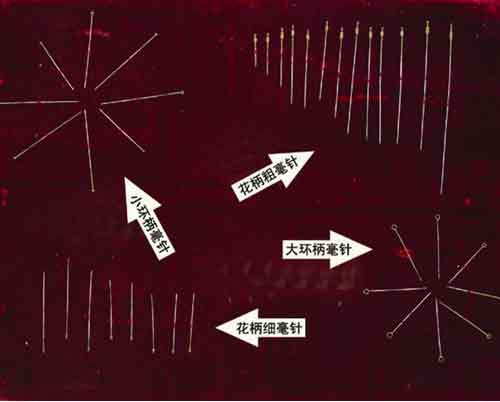
The filiform needles are usually used in clinical treatment. Most of them are made of stainless steel. The gauge of the filiform needles is determined on the basis of the length and diameter of the needle body. Usually the needles ranging from 25~75mm (1~3 cun) in length and size 28~30 (0.32~0.38mm in diameter) are frequently used in clinical treatment. The filiform needles are used in a wide range, which extends from internal medicine, external medicine to gynecology, pediatrics and ENT.
-
-
Filiform Needles
Precautions:
-
① Patients who are suffering from hunger, exhaustion and excessive mental stress are considered unfit for immediate puncture. For debilitated patients and patients with deficiency of both qi and blood, it is advisable to apply mild manipulations and they' d better choose a recumbent posture.
-
② For pregnant women in the first three months points on the lower abdomen should not be punctured. For pregnant women beyond the first three months, points on the abdomen and lumbosacral region are also not selected. In addition, during pregnancy, these points, such as Sanyinjiao (SP6), Hegu (LI4), Kunlun (BL60) and Zhiyin (BL67), which are effective for stimulating menstrual flow and promoting blood circulation are forbidden to be punctured. Women in periods should usually not be given acupuncture unless menstruation needs regulated.
-
③ Points on the vertex of infants should not be needled when the fontanel is not closed.
-
④ It is not advisable to give acupuncture therapy to patients who are vulnerable to spontaneous bleeding or have incessant bleeding after an injury.
-
⑤ Points on the areas with infection, ulcer and scar should not be needled.
-
⑥ Do not make perpendicular and deep insertion of needles into the points on the chest, hypochondrium, lower back and back, and it is especially prohibited for patients with enlarged liver, spleen or emphysema.
-
⑦ Points around the eyes and on the neck, such as Fengfu (GV16) and Yamen( GV15), and those on the vertebrae should be carefully needled. Appropriate angle is the first consideration. Also, the lifting, thrusting and twirling of the needle in a large amplitude or long-time retention of needles should be avoided so as to prevent any piercing injury to important tissues and organs, causing serious consequences.
-
⑧ For patients who suffer from retention of urine'take care of the direction, angle and depth of needle insertion. When acupuncture is applied to the lower abdomen, be cautious not to injure the urinary bladder and other organs, causing unexpected consequences. |
|
|
|
|
|
|