|
|
|
Winds-stroke (apoplexy)
|
-
Winds-stroke is characterized by sudden collapse, coma, deviation of the mouth, dysphasia and hemiplegia, or only by deviation of the mouth and hemiplegia as the chief symptoms. It is an acute cerebrovascular disease in Western medicine, including cerebral infarction, intracerebral hemorrhage, cerebral embolism, subarachnoid hemorrhage, etc
-
【Treatment】
-
(1) Acupuncture
-
①Paralysis of extremities
-
Treating principles: To regulate qi and blood, extinguish wind and dredge meridians with the uniform reinforcing-reducing method
-
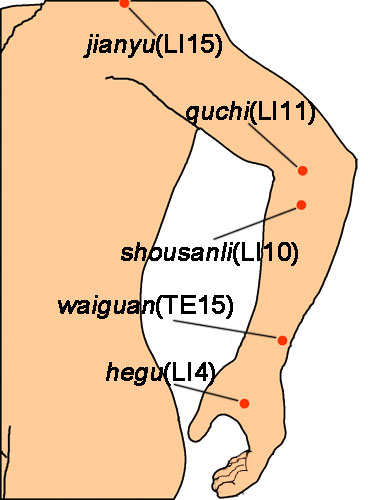
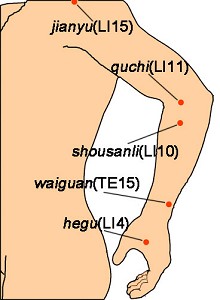
Prescription: Upper limbs: Jianyu (LI15), Quchi (LI11), Shousanli (LI10), Waiguan (TE5), Hegu (LI4)
-
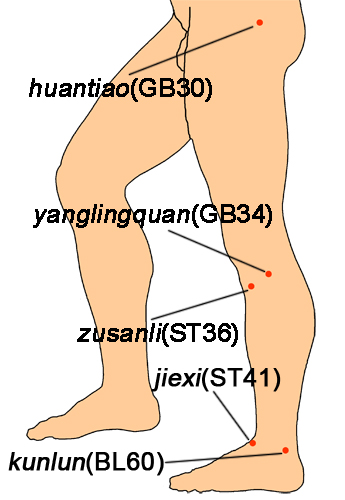
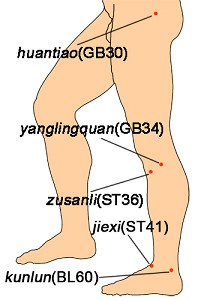
Lowe Lower extremities: Huantiao (GB30), Yanglingquan (GB34), Zusanli (ST36), Jiexi (ST41), Kunlun (BL60)
-
② Facial Paralysis
-
-
Treating principles: To regulate qi and blood, extinguish wind and dredge meridians with the evem reinforcing-reducing method
-
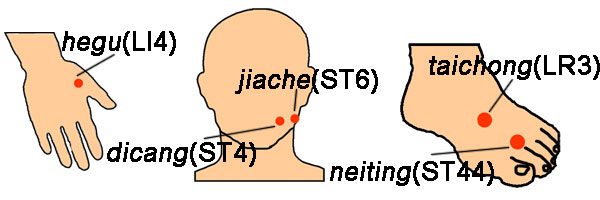
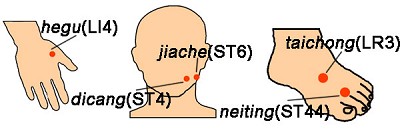
Prescription: Dicang (ST4), Jiache (ST6), Hegu (LI4), Neiting (ST44), Taichong (LR3)
-
③ For patients with symptoms of coma, clenched jaws and fists, reddened complexion and harsh breathing, gurgling with sputum, difficulty in urination and constipation, wiry, slippery and rapid pulse:
-
Treating principles: To extinguish wind for resuscitation, clear fire and eliminate sputum, with the reducing method or bloodletting
-
Prescription: Shuigou (GV26), Jing-well points, Taichong (LR3), Fenglong (ST40), Laogong (PC8)
-
④ For patients with closed eyes and open mouth, incontinence of urine, cold limbs and thready and weak pulse
-
Therapeutic principles: Moxibustion with multiple moxa cones applied to restore yang from collapse
-
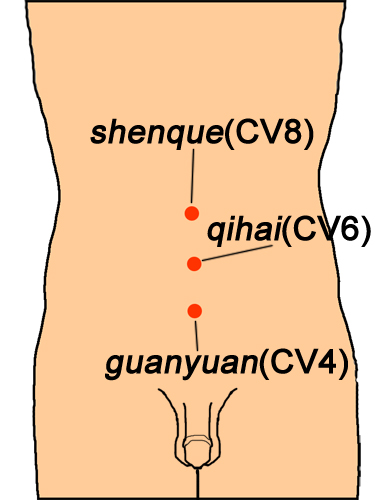
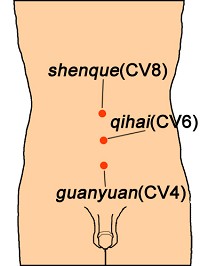
Prescription: Guanyuan (CV4), Qihai (CV6), Shenque (CV8) (salt-partition moxibustion)
-
(2) Scalp Acupuncture: Motor zone, accompanied by the opposite motor area and foot motor sensory area; speech area added for aphasia
-
(3) Electro-Acupuncture: Choose 2~3 pairs of points on the extremities mentioned above, after insertion and manipulation of the needles, the electric stimulator is connected. The intermittent or sparse waves are adopted for 20 minutes.
-
(4) Cupping: For hemiplegia
-
【Remarks】
-
Comprehensive emergency treatment must be applied to wind-stroke at the acute stage.
-
【Appendix】
-
Wind-stroke treated by the “Resuscitation-Inducing Method”
-
The “resuscitation-inducing” method is employed in the treatment of cerebrovascular diseases.
-
Treatment:
-
Prescription:
-
Main points: Neiguan (PC6), Renzhong (GV26), Sanyinjiao (SP6)
-
Auxiliary points: Jiquan (HT1), Weizhong (BL40), Chize (LU5)
-
Subsidiary points: For difficulty in swallowing add Fengchi (GB20), Yifen (TE17), Wangu (GB12).
-
For clenched fists add Hegu (LI4).
-
For aphasia and stiffness of the tongue add Lianquan (CV23), Jinjin (EX-HN12) (bloodletting) and Yuyie (EX-HN13) (bloodletting).
-
For strephenopodia, joint puncture is applied to Qiuxu(GB40) and Zhaohai (KI6).
-
Manipulation:
-
N(PC6): The needle is perpendicularly inserted for 0.5~1 cun. Twirling and lifting-thrusting technique is applied, combined with the reducing method for 1 minute.eiguan
-
Renzhong (GV26): The needle is obliquely punctured toward the bony nasal partition for 0.3~0.5 cun. The forceful sparrow-pecking method is applied, until there are tears in the eyes or tears running.
-
Sanyinjiao (SP6): The needle is inserted obliquely to form an angle of approximately 45o between the body surface and the inner border of the tibia at a depth of 1~1.5 cun. The lifting-thrusting reinforcing method is employed till there are three times of tics in the diseased lower limb.
-
Time for treatment:
-
Acupuncture treatment is given twice a day, and 10 days make a course for 3~5 successively courses .
|
|
|
|
|