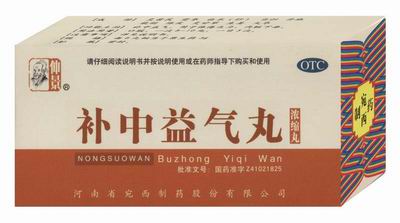
|
| Key Characteristic |
It is an OTC patent herbal preparation, used in the department of internal medicine |
| Formula Basis |
Pi Wei Lun (Treatise on the Spleen and Stomach), written by Li Dongyuan of the Yuan dynasty
|
| Ingredients |
Radix Astragali Praepareta Cum Melle, Radix Codonopsis, Radix et Rhizoma Glycyrrhizae Praeparata Cum Melle(processed with honey), Rhizoma Atractylodis Macrocephalae (stir-baked), Radix Angelicae Sinensis, Rhizoma Cimicifugae, Radix Bupleuri, Pericarpium Citri Reticulatae
|
| Actions |
To reinforce the middle-energizer to replenish qi and elevate yang to cure drooping
|
| Indications |
Deficiency in the spleen and stomach and sinking of spleen qi, manifested as diarrhea, prolapse of the rectum or uterus, lassitude, anorexia and abdominal distension, loosen stools or chronic diarrhea, prolapse of the anus or prolapse of the rectum or uterus, in addition, used for malnutrition, anemia, chronic gastritis, chronic hepatitis, common cold, bronchitis, pneumonia, pulmonary heart disease, etc.
|
| Usage and Dosage |
Oral administration: Watered pills: 6g each time, 2~3 times a day, taken with warm boiled water. |
| Precaution |
1.It is not suggested to prescribe to patients with the exterior syndrome, marked by adversion to cold, fever and abdominal distension due to crapulence. 2. It is forbidden to prescribe with patients with common cold. 3. Use with cautions in patients with high blood pressure. 4. It is incompatible with Rhizoma et Radix Veratri, and use with cautions in patients with fever from yin deficiency.
|
| Pharmacological study |
It acts to regulate the immune system, digestive system and urinary system. |
| |
|
|