| |
| Examination for Practitioners at the Imperial Medical Institution of the Qing Dynasty (1644~1911) |
| |
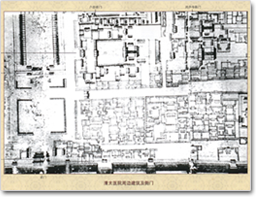
Map of the Imperial Medical Institution
Those who studied medicine at places other than the government-run schools must have a good command of the following knowledge, such as Nei Jing Zhu Shi (Annotated Canon of Medicine), Ben Cao Gang Mu (Compendium of Materia Medica) and Shang Han Lun (Treatise on Cold-induced Diseases) . The local government would recommend the students who were good at medical theory and skills to the provincial authority. After being approved, they had the right to take part in the examination of the Imperial Medical Institution. Those who passed the examination would also be granted the title of “assistant practitioner.”
The Imperial Medical Institution specified detailed regulations for the examination, covering the range of examination and paper design, qualification assessment, duration of examination, requirement of the answer sheet and how
to read and mark the examination paper. From above we can see how strict the procedures were for the
medical examination in the Qing Dynasty (1644~1911). |
| |
|
|
|

